
- This event has passed.
UNDP Highlights Islamic Finance as a Catalyst for Women’s Entrepreneurship at The Missing Trillion Consultation in Istanbul
November 4 @ 08:00 - 17:00 UTC+3
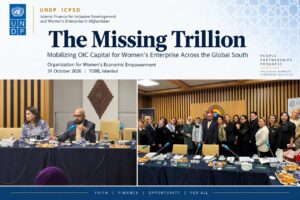
Istanbul, Türkiye, 31 October 2026 – The United Nations Development Programme (UNDP) contributed to The Missing Trillion: Mobilizing OIC Capital for Women’s Enterprise Across the Global South, a high-level consultation convened by the Maida Nazir Organization for Women’s Economic Empowerment (MAIDA), a member of the ICCD family, and co-hosted by the TOBB Women Entrepreneurs Council. Held at the TOBB Building in Istanbul as part of the B57+ Business Leaders’ Summit, the consultation brought together institutional representatives and business leaders to explore how capital, commercial networks, and policy cooperation across the Organisation of Islamic Cooperation (OIC) can expand opportunities for women entrepreneurs.
The concept of the “Missing Trillion” refers to the vast economic potential that remains unrealized when women are unable to participate fully in economic life. As a strategic partner of the summit, MAIDA used the high-level consultation to examine the links between women’s access to finance and broader economic opportunities, including decent employment, corporate and public procurement, export markets, and participation in business leadership and investment decision-making.
Chaired by MAIDA Secretary General Natavan Mammadova, the programme featured contributions from ICCD Secretary General Sheikh Yousef Hassan Khalawi; representatives of the TOBB Women Entrepreneurs Council; SESRIC Director General Zehra Zümrüt Selçuk; WDO Executive Director Counsellor Sarah Ismail AlShoura; and Lazzat Ramazanova, Chairwoman of the Council of Women Entrepreneurs of Turkic States. The discussions drew on findings from SESRIC’s OIC Women and Development Report 2026, presented by Mazhar Hussein, Director of SESRIC’s Economic and Social Research Department, alongside broader international research on women’s economic empowerment and participation.
Representing UNDP, Dr. Muniruddeen Lallmahomood, Islamic Finance Portfolio Lead at UNDP’s Istanbul International Center for Private Sector in Development (ICPSD), delivered a presentation on the role of Islamic finance in promoting inclusive development and supporting women-led enterprises in Afghanistan.
Drawing on the work of the Global Islamic Finance and Impact Investing Platform (GIFIIP) and UNDP’s experience in Afghanistan, the presentation highlighted how Islamic finance can serve as an effective tool for advancing women’s entrepreneurship and inclusive economic development. It underscored the importance of combining Sharia-compliant financial solutions with capacity-building initiatives, business development support, and market access to help women overcome barriers to finance and expand their enterprises.
The high-level consultation also explored a proposed W57+ cooperation platform and a two-year pilot initiative focused on opportunities in Türkiye, Egypt, Saudi Arabia, Pakistan, and Azerbaijan. The proposed framework links country-specific challenges with financial, commercial, and institutional responses, including tailored financing solutions, supplier development programmes, and business networks, with a focus on achieving measurable outcomes for women-owned enterprises.
UNDP’s contribution demonstrated how lessons learned in fragile and crisis-affected contexts can inform broader efforts to mobilize capital for women’s enterprises across the Global South. Through GIFIIP, UNDP supports capacity building, institutional collaboration, and stronger connections between investors and development opportunities, helping translate Islamic finance into more inclusive, resilient, and sustainable economic outcomes.